Don't build what you'll spend years maintaining.
Standing up a portal is achievable. Keeping it evergreen as suppliers, products, billing and customer expectations change is where the real cost lives, and it never stops.
Virtualplatform - the Telco automation people
The build
The initial project has a scope, a budget and an end date. It's the part everyone estimates, and it's the part that looks affordable on a slide. It is also the smallest part of the total cost of ownership.
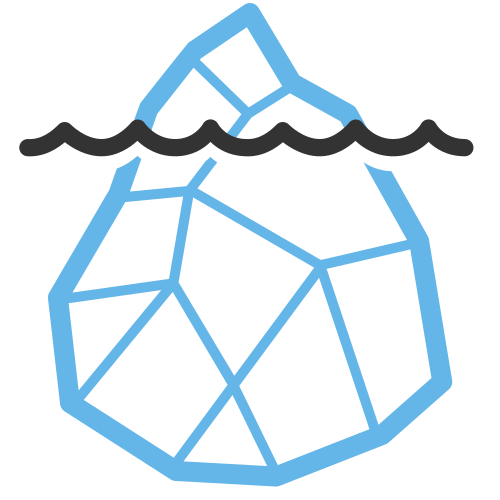
The lifetime
Going live is only the beginning. Every supplier change, API update, failed order, billing exception and rising customer expectation becomes your team's ongoing responsibility. That means more specialist salaries, more support overhead and more management attention - pulling focus and investment away from your core business and the products you actually sell.
What you inherit the day you go live.
Each of these is manageable in isolation. Together, they become a permanent engineering and operations commitment.
API changes
Supplier APIs evolve constantly. Every change means rework, testing and redeployment on your side.
Supplier changes
New suppliers, retired products and shifting commercial terms all ripple through your integrations.
Failed orders
Edge cases and rejections need handling, retries and human workflows you have to design and maintain.
Migrations
Product and network migrations turn into major projects when your tooling wasn't built for them.
Billing exceptions
Reconciliation, proration and disputes generate a long tail of exceptions that never fully goes away.
Assurance
Fault management, monitoring and case handling are ongoing operational commitments, not one-off builds.
Certification
Keeping certifications current with suppliers is recurring work with real deadlines and consequences.
Workflow changes
Processes change as you grow. A custom portal has to be re-engineered every time they do.
Customer experience
Expectations for self-service, notifications and status keep rising, and your build has to keep pace.
Every hour on plumbing is an hour not spent on customers.
The teams that win in connectivity aren't the ones with the biggest integration backlog. They're the ones spending their time on products, service and growth. Virtualplatform carries the operating layer so you can focus there.
Workflow Automation is Just the Beginning
Building integrations solves one problem. Automating the business around them creates real operational leverage.
Virtualplatform's next-generation Workflow Engine extends orchestration beyond APIs, allowing providers to visually design, automate and optimise every stage of the service lifecycle without traditional software development.
Using a low-code visual canvas, providers will be able to model business processes, introduce decision points, trigger notifications, coordinate multiple suppliers and automate complex customer journeys - all while reusing the same underlying platform.
Whether you're provisioning a new customer, bundling products across suppliers, coordinating appointments or orchestrating billing and lifecycle events, workflows become configurable rather than hard-coded.
Instead of commissioning another development project every time your business evolves, Virtualplatform evolves with you.
- Visual low-code workflow designer
- Multi-supplier process orchestration
- Conditional business rules and decision logic
- Automated customer notifications
- Product bundling and service orchestration
- Approval and exception handling
- Lifecycle automation from qualification through billing
- Extensible framework for future AI and MCP-driven workflows
Buy the operating layer. Keep your focus on customers.
See how Virtualplatform stays evergreen so your team doesn't have to.